How Shell and Tube Heat Exchangers Work: 5 Common Types
- Teknoflow SEO
- Feb 17
- 4 min read

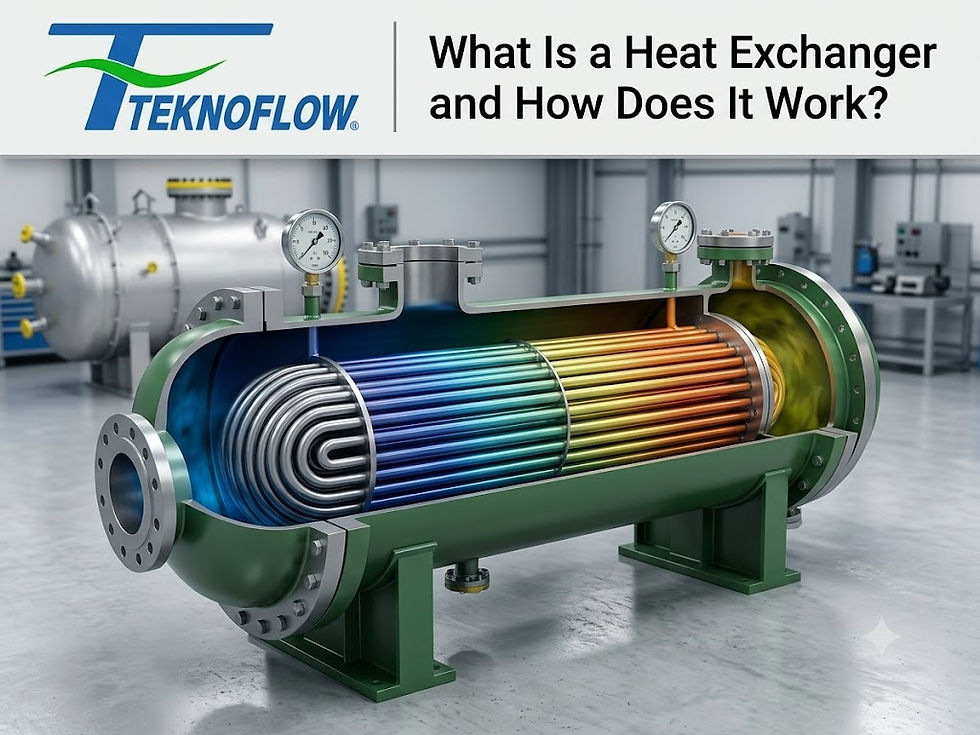
Shell and tube heat exchangers are among the most widely used and efficient solutions for transferring heat between two fluids. Known for their reliability and versatility, these devices are essential in industries such as power generation, chemical processing, oil and gas, and petrochemical plants. A shell and tube heat exchanger, often abbreviated as S&T heat exchanger, consists of a series of tubes housed within a cylindrical shell. One fluid flows through the tubes while the other flows over them within the shell, allowing heat transfer through the tube walls. The temperature difference between the two fluids is the primary driving force behind the heat exchange process.
The compact design, robust construction and ease of maintenance make shell and tube heat exchangers a preferred choice in applications requiring high temperature and pressure ranges. Their working principle ensures effective thermal energy transfer while maintaining system efficiency, making them indispensable in modern industries.
Working Principle of a Shell and Tube Heat Exchanger
The shell and tube heat exchanger working principle relies on the temperature difference between the two fluids. Typically, the hot fluid passes through the tubes while the cold fluid flows over the tubes inside the shell, or vice versa. This temperature difference drives the heat from the hotter fluid to the cooler one, effectively transferring thermal energy.
To enhance heat transfer efficiency, these exchangers often include multiple tube passes. Increasing the number of passes raises the heat transfer coefficient. Additionally, baffles are installed inside the shell to increase fluid turbulence, which further improves heat exchange between the fluids.

Figure 1 illustrates a typical shell and tube heat exchanger, showing the tube-side inlet and outlet nozzles. The configuration can have either an even or odd number of tube passes, which determines the nozzle placement on the headers.
Types of Shell and Tube Heat Exchangers
1. Tube Bundle Heat Exchanger
The tube bundle forms the core of a shell and tube heat exchanger. It consists of multiple tubes through which the fluid flows. Tube bundles are designed to be removable, allowing easy inspection and maintenance without dismantling the entire system.
Figure 2 – Typical tube bundle of a shell and tube heat exchanger
2. Fixed Tube Sheet Heat Exchanger
In a fixed tube sheet exchanger, the tubes are welded directly to the shell. This design is simple and economical, offering durability and reliability. Cleaning can be performed either mechanically or chemically, but the fixed construction limits thermal expansion flexibility.
Figure 3 – Example of a fixed tube heat exchanger
3. Floating Head Removable Bundle Heat Exchanger
The floating head design allows the rear header to move freely, making the tube bundle removable. This feature simplifies maintenance and accommodates thermal expansion, reducing stress on the tubes during high-temperature operations.
Figure 4 – Example of a floating head removable bundle heat exchanger
4. U-Tube Heat Exchanger
U-tube exchangers feature continuous tubes bent into a “U” shape. The free-floating bend allows the tube to expand and contract with temperature changes, eliminating the need for expansion joints. However, cleaning the bends can be challenging.
Figure 5 – Typical U-tube heat exchanger
5. Vertical Combined Feed Exchanger (VCFE) / Texas Towers
VCFEs, also known as Texas Towers, are vertical shell and tube heat exchangers used in power plants and other large-scale industrial applications. They allow combined fluid feed and optimize space while providing excellent heat transfer efficiency.
Figure 6 – Example of a VCFE / Texas Tower
Industry leaders like Teknoflow specialize in cleaning and inspecting twisted tube heat exchangers, ensuring optimal performance and longevity. Regular cleaning shell and tube heat exchanger surfaces is crucial to prevent fouling, maintain heat transfer efficiency, and reduce energy consumption in industrial plants.
Applications of Shell and Tube Heat Exchangers
Shell and tube heat exchangers are widely used in:
Power Plants: For cooling and heating fluids, steam condensation, and heat recovery systems.
Chemical and Petrochemical Industries: To control process temperatures and transfer heat between chemical streams.
Oil and Gas: In refining processes, oil cooling, and gas liquefaction.
Fertilizer Production: To regulate reaction temperatures and improve process efficiency.
Their versatility, robust construction and ability to handle high pressure and temperature make them essential in almost all heavy industries.
Maintenance and Cleaning
Regular maintenance is vital for ensuring the efficiency and longevity of a shell and tube heat exchanger. Tube bundles can accumulate fouling, scaling, or corrosion over time. Mechanical or chemical cleaning methods are used to remove deposits and restore optimal heat transfer performance. Floating head and U-tube designs make maintenance easier compared to fixed tube sheet exchangers.
FAQs
Q1: What is a shell and tube heat exchanger?
A shell and tube heat exchanger is a device that transfers heat between two fluids through a series of tubes inside a cylindrical shell. It is widely used in power plants, chemical, and petrochemical industries for efficient thermal energy transfer.
Q2: How does a S&T heat exchanger work?
The working principle relies on the temperature difference between fluids. One fluid flows through the tubes while the other flows over them inside the shell, transferring heat from the hot fluid to the cold one efficiently.
Q3: What are the types of shell and tube heat exchangers?
The main types include fixed tube sheet, floating head removable bundle, U-tube, and vertical combined feed exchangers (VCFE). Each design offers specific advantages in terms of maintenance, thermal expansion, and heat transfer efficiency.
Q4: How is cleaning shell and tube heat exchanger performed?
Cleaning can be mechanical or chemical. Floating head and U-tube exchangers allow easier removal of tube bundles for thorough cleaning, ensuring optimal heat transfer and preventing fouling in industrial applications.
Shell and tube heat exchangers remain the backbone of thermal management in modern industries. Whether used in a shell and tube heat exchanger power plant or chemical processing, understanding their working principle and maintenance requirements ensures maximum efficiency and reliability. Regular inspection and cleaning extend the lifespan of these exchangers while sustaining optimal heat transfer performance.


Comments