What Is a Heat Exchanger and How Does It Work?
- Teknoflow SEO
- Jun 20
- 5 min read

What Is a Heat Exchanger?
Heat exchangers are quietly at work in almost every part of modern life — from the boiler keeping your home warm to the industrial systems generating the electricity that powers it. Despite how common they are, many people have never thought about what a heat exchanger actually is or how it works. Teknoflow Green Equipments Pvt. Ltd., a specialist heat exchanger manufacturer, breaks it all down below.
Use the navigation below to jump to a section:
What is a heat exchanger?
How do heat exchangers work?
Types of heat exchanger
Common applications
Design and materials
Installation and maintenance
FAQs
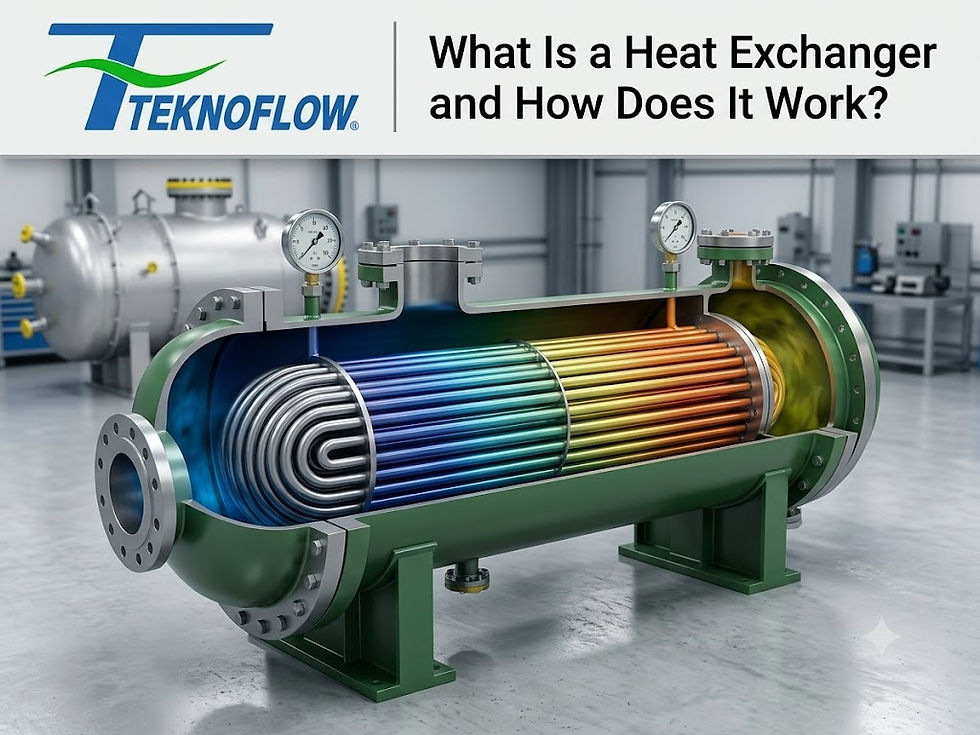
What Is a Heat Exchanger?
A heat exchanger is a device that transfers thermal energy between two fluids or mediums — without ever allowing them to mix. It does this through conduction, moving heat from a hotter medium to a cooler one in a controlled and efficient way.
They're used wherever temperature control matters: to protect equipment, recover wasted energy, or keep a process running safely. Oil coolers, for instance, pass cold water alongside hot oil tubing, drawing heat away from the oil without the two ever coming into contact. The same principle applies whether you're cooling a car engine or managing heat in a nuclear power facility.
How Do Heat Exchangers Work?
The heat exchanger working principle combines conduction and convection to move thermal energy from one flow to another. In most applications, this happens within a sensible heat range — meaning the temperature of the fluid changes, but its physical state doesn't. In some specialist cases, phase change and the associated enthalpy (latent heat) is also involved.
The goal is always the same: move heat in a way that improves efficiency, protects equipment, or makes a process viable in the first place. Without heat exchangers, many industrial and domestic systems simply wouldn't function.
Types of Heat Exchanger
Different applications call for different designs. Here are the most widely used types:
Shell and Tube Heat Exchanger
The shell and tube heat exchanger is one of the most established and trusted designs in industry. One medium flows through an inner tube; the other flows through the surrounding shell. The two fluids never meet — only heat passes between them.
They come in several configurations: counterflow (fluids moving in opposite directions), parallel flow (same direction), and crossflow (perpendicular). The right choice depends on the fluids involved and the heat transfer goals. Teknoflow Green Equipments Pvt. Ltd. always assesses the application carefully before recommending a configuration.
Finned Tube
Finned tube heat exchangers are designed to maximise surface area, which is especially important when working with fluids that have low thermal conductivity — air being the most common example. A series of evenly spaced fins are threaded onto the tubes, dramatically increasing the area available for heat transfer. Gas coolers are a typical application.
Air-Cooled
HVAC heat exchanger systems frequently use air-cooled designs, where a fan drives air across a fluid-carrying tube to remove heat. Air-cooled condensers work on this principle, cooling a gaseous stream past its dew point until it condenses. In some installations, natural airflow replaces the fan entirely.
Plate Type
Plate heat exchangers use a stack of plates to create multiple parallel flow channels. While effective, finned tube designs are now more widely used in most applications due to their greater efficiency at scale.
Common Applications
Heat exchangers appear in more places than most people realise:
At home, they're central to combi boilers and refrigeration systems. In public spaces, they keep swimming pools at a comfortable temperature. In the automotive world, radiators and engine cooling systems rely on heat exchangers to prevent overheating. Industrially, they're found in power generation, food manufacturing, chemical processing, and aerospace and marine transport. In defence, they cool propulsion systems on naval ships and submarines, including nuclear-powered vessels.
Design, Materials, and Custom Heat Exchanger Design
No two applications are identical, which is why custom heat exchanger design is at the heart of what Teknoflow does. The design process begins with understanding the specific process: what fluids are involved, what temperatures and flow rates are expected, what the heat transfer goal is, and what budget and maintenance constraints apply.
Material selection is critical. Conductive metals such as copper and steel are the most common choice, but they must be compatible with the fluids in use. For highly corrosive environments — acids, chlorinated saltwater, or aggressive chemicals — specialist materials are selected to resist degradation. Ceramics and engineered polymers offer alternatives in extreme applications.
The cooling or heating medium also matters. Water, oil, water-glycol, and seawater each suit different scenarios. Air is widely used too, particularly in finned configurations where its lower thermal conductivity is offset by the extended surface area.
Installation and Maintenance
Industrial heat exchangers are installed by experienced engineers to ensure correct integration and performance from day one. For domestic units, installation is typically handled as part of the broader system setup.
Ongoing maintenance is essential to long-term performance. Descaling heat exchangers is one of the most common maintenance tasks — scale and fouling build up over time and reduce thermal efficiency. The right maintenance schedule depends on the fluids used, the operating environment, and how critical the heat exchanger is to the overall process.
Teknoflow Green Equipments Pvt. Ltd. factors all of this into the design phase, ensuring the unit is accessible, durable, and matched to your maintenance capabilities. A full aftercare service is available to support the lifespan of every unit we supply.
FAQs
1. How Do I Know If My Heat Exchanger Is Failing?
Common warning signs include reduced heating or cooling performance, unusual pressure drops, fluid leaks, or contamination between the two fluid streams — which suggests internal corrosion or a breach in the barrier between them. In HVAC heat exchanger systems, reduced airflow efficiency or unexpected energy consumption can also indicate a problem. If you notice any of these symptoms, it's worth having a qualified engineer carry out an inspection promptly. Catching issues early usually means simpler, less costly intervention.
2. What's the Right Heat Exchanger for My System?
The answer depends on several factors: the fluids or gases involved, the temperatures and flow rates, the space available, and how the unit will be maintained. A shell and tube heat exchanger suits many industrial liquid-to-liquid applications, while finned tube designs excel where air or low-conductivity gases are involved. For HVAC or air-cooled applications, fan-assisted designs are often the most practical. The best approach is always to discuss your specific process with a specialist — there's rarely a one-size-fits-all answer.
3. Heat Exchanger Repair vs Replacement: When to Choose Each?
Repair is often the more cost-effective option, particularly when damage is localised — such as a single tube failure in a shell and tube heat exchanger — and the rest of the unit is in good condition. Descaling heat exchangers and repairing minor leaks or corrosion can significantly extend service life. Replacement becomes the better choice when corrosion is widespread, when the design no longer meets the demands of the process, or when the cost of repair approaches the cost of a new unit. A qualified engineer will always advise honestly, with your budget and operational needs in mind.
Want to explore further? Visit our blog on key considerations for bespoke heat exchanger design, or get in touch with the Teknoflow Green Equipments Pvt. Ltd. team to discuss your specific project.


Comments