Understanding Shell and Tube Heat Exchangers: How They Work and Why Industries Use Them
- Teknoflow SEO
- Mar 12
- 5 min read

Heat exchangers are essential in many industrial processes where heat must be transferred efficiently from one fluid to another. Among the many types available, the Shell And Tube Heat Exchanger is one of the most widely used due to its durability, reliability, and ability to handle high temperatures and pressures. From chemical plants to power stations, this equipment plays a key role in maintaining stable and efficient operations.

Understanding how a shell tube heat exchanger works and why industries rely on it can help businesses select the right system for their thermal management needs.
What Is a Shell and Tube Heat Exchanger?
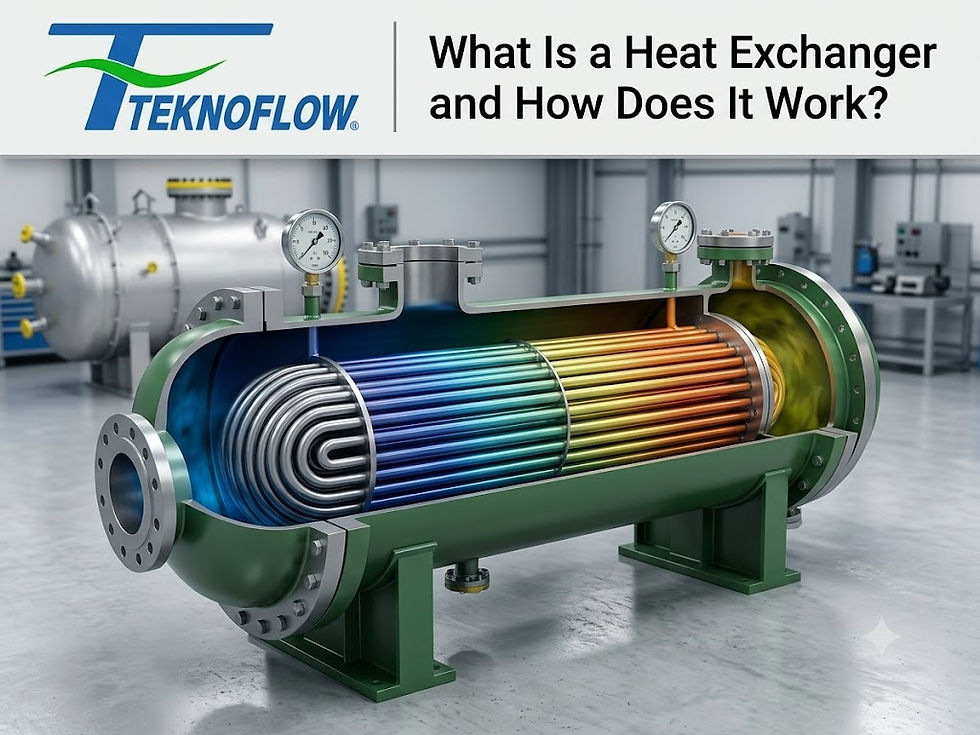
A Shell And Tube Heat Exchanger is a type of heat transfer equipment that consists of a series of tubes enclosed within a cylindrical shell. One fluid flows through the tubes while another flows around the tubes within the shell. Heat is transferred between the two fluids without them mixing.
This design allows industries to efficiently control temperature in various processes. The system can be used for heating, cooling, condensation, and evaporation depending on the application.
Because of its strong construction and flexible design, the shell tube heat exchanger is suitable for demanding industrial environments where temperature control is critical.
How Shell and Tube Heat Exchangers Work
The working principle of a Shell And Tube Heat Exchanger is based on heat transfer between two fluids at different temperatures.
One fluid passes through the internal tubes while the other circulates through the outer shell surrounding the tubes. As the fluids move through the system, heat transfers through the tube walls from the hotter fluid to the cooler one.
This process continues until the desired temperature change is achieved. The system’s design ensures efficient heat transfer while maintaining separation between the two fluids.
In many industrial processes, this method is used as a water to water heat exchanger, where hot water transfers heat to cooler water for temperature control.
Types of Shell and Tube Heat Exchangers
Different industrial applications require different configurations of heat exchangers. One common design is the fixed tube sheet heat exchanger, where tubes are permanently attached to the tube sheets.
This design is widely used because it is simple, durable, and cost-effective. However, other designs may be used when easier maintenance or thermal expansion flexibility is required.
Some industries also require specialized systems such as a custom shell and tube exchanger that is designed according to specific process requirements, temperature levels, and pressure conditions.
Importance of Heat Exchanger Efficiency
The performance of a Shell And Tube Heat Exchanger is measured by how effectively it transfers heat between fluids. Higher shell and tube heat exchanger efficiency means better energy use and lower operational costs.
Efficient heat exchangers help reduce energy consumption, improve process stability, and maintain consistent product quality. Engineers often focus on factors like tube design, flow patterns, and material selection to improve efficiency.
When industries invest in high-performance heat exchangers, they can achieve better heat recovery and more sustainable operations.
Cleaning and Maintenance of Heat Exchangers
Regular maintenance is essential to maintain optimal performance. Over time, deposits such as scale, rust, or chemical residues can accumulate inside the tubes, reducing heat transfer efficiency.
Proper shell and tube heat exchanger cleaning helps remove these deposits and restore system performance. Cleaning methods may include mechanical cleaning, chemical cleaning, or high-pressure water flushing depending on the type of fouling.
Routine maintenance not only improves efficiency but also extends the lifespan of the equipment and prevents unexpected system failures.
Industrial Applications of Shell and Tube Heat Exchangers
The Shell And Tube Heat Exchanger is widely used across many industries due to its versatility and durability.
Some common applications include:
Chemical and petrochemical processing
Oil and gas refining
Power generation plants
Pharmaceutical manufacturing
Food and beverage processing
HVAC and refrigeration systems
In these industries, heat exchangers help regulate temperatures, recover waste heat, and maintain safe operating conditions.
Because of these benefits, many companies work with reliable shell and tube heat exchanger manufacturers to obtain high-quality equipment designed for long-term performance.
Benefits of Custom Heat Exchanger Solutions
Every industrial process has unique thermal requirements. Standard equipment may not always meet these needs, which is why many companies choose a custom shell and tube exchanger.
Custom designs allow engineers to optimize the number of tubes, shell size, material type, and flow configuration. This ensures the heat exchanger performs efficiently within specific operational conditions.
Businesses looking to upgrade their systems or expand production often search for options to buy shell and tube heat exchanger units that meet their exact process requirements.
Why Industries Prefer Shell and Tube Heat Exchangers
There are several reasons why the Shell And Tube Heat Exchanger remains one of the most trusted heat transfer solutions.
First, it can handle high temperatures and pressures, making it suitable for demanding industrial processes. Second, the design allows easy scalability for large systems. Third, it provides reliable heat transfer efficiency over long periods of operation.
Additionally, the system is relatively easy to maintain when proper cleaning and inspection routines are followed.
Final Thoughts
The Shell And Tube Heat Exchanger continues to be one of the most reliable solutions for industrial heat transfer applications. Its simple yet effective design allows industries to manage temperature control efficiently while maintaining safety and operational stability.
With options such as fixed tube sheet heat exchanger designs, customized systems, and efficient cleaning methods, businesses can ensure long-term performance and energy efficiency. By working with experienced shell and tube heat exchanger manufacturers, industries can obtain high-quality equipment that supports reliable and sustainable operations.
FAQs
1. What is the main purpose of a shell and tube heat exchanger?
A Shell And Tube Heat Exchanger transfers heat between two fluids without mixing them. One fluid flows through tubes while the other flows through the surrounding shell. This allows efficient heating or cooling in industrial processes.
2. What is a fixed tube sheet heat exchanger?
A fixed tube sheet heat exchanger is a design where the tubes are permanently attached to the tube sheets. This structure makes the system strong and cost-effective. It is commonly used in applications with moderate temperature changes.
3. Why is shell and tube heat exchanger cleaning important?
Regular shell and tube heat exchanger cleaning removes scale, debris, and chemical deposits that reduce heat transfer efficiency. Clean systems perform better and consume less energy. Maintenance also helps extend equipment life.
4. How do I choose the right shell and tube heat exchanger?
When planning to buy shell and tube heat exchanger equipment, it is important to consider operating pressure, temperature, and fluid type. Working with reliable shell and tube heat exchanger manufacturers ensures proper system design. This helps achieve higher shell and tube heat exchanger efficiency.


Comments